
We found the whole story in a bookshop café, hiding from the noise, which is exactly the sort of place Hanoi keeps its answers.
Tranquil Books & Coffee is tucked away from the bustle of the Old Quarter. Coffee and books under one roof. We had been Bean Hunting for three days by then, climbing staircases we were not certain we were allowed to climb, and we had drunk a great deal of coffee without once asking where any of it came from. We settled in with a couple of cups and a book about Vietnam, and somewhere in it was a sentence that stopped us.
Coffee has not always been here.
It seems an obvious thing to say about a country that now grows more coffee than almost anywhere on earth. But we had arrived assuming coffee was simply Vietnamese, the way pho is Vietnamese, the way the Old Quarter is Vietnamese. It is not. It is an import, and a fairly recent one, and the story of how it settled in is not a story about the French at all. It is a story about a plant.

Hanoi
What the French brought, and why they were wrong
French Catholic missionaries are generally credited with bringing the first coffee plants to Vietnam around 1857, at church sites that later tradition places in the north. Both the date and the location are what is commonly reported rather than anything fixed by a surviving record, and we hold them as exactly that: reported, not proven. They planted arabica.
They planted arabica because arabica was what Europeans drank, and what Europeans drank was, to the nineteenth-century colonial mind, simply what coffee was. Arabica was the superior bean, the one with the reputation, the one that fetched a price in Marseille and Paris. Robusta existed, but it was not what you planted if you were planting for Europe. So arabica went into the ground, first as a botanical curiosity and then, as the colonial project hardened, as a commercial crop.
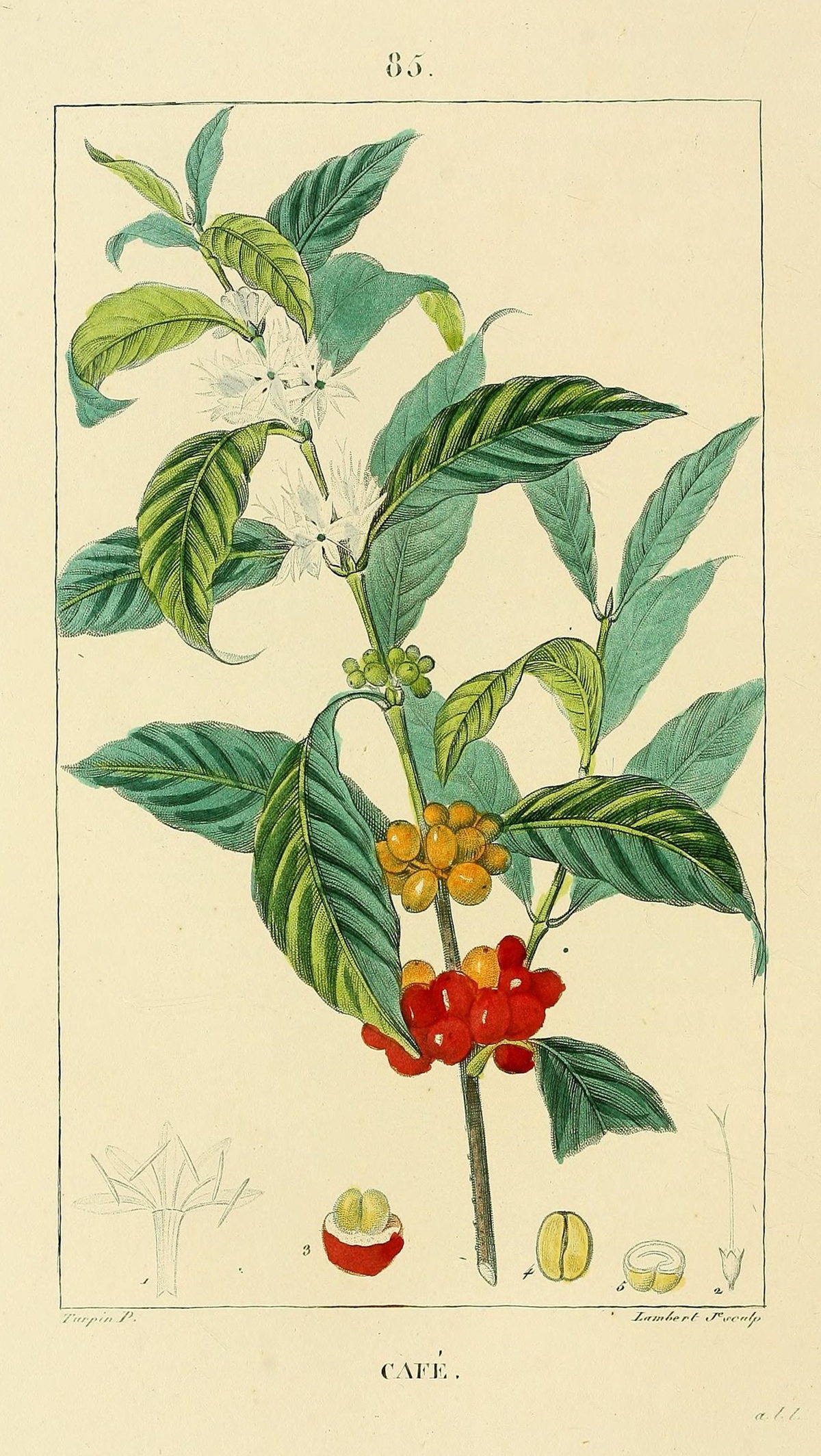
P.-J.-F. Turpin, Café (Coffea arabica), plate 85, in F.-P. Chaumeton et al., Flore médicale, vol. 2, Paris, 1829; engraved by Lambert jeune. Smithsonian Libraries / Biodiversity Heritage Library. Digital image CC BY 2.0; historical artwork public domain.
It is worth being precise here, because it is easy to get wrong and we got it wrong the first time we wrote this. Those first plantings were the work of the church, not the colonial state, and they were in the north. French political control of the north, Tonkin, did not arrive until the protectorate of 1883-84. French rule was established in the south first, in Cochinchina, the eastern provinces ceded in 1862 and the west annexed in 1867, and reached Tonkin a quarter of a century after those first mission trees were in the ground. So in the north, coffee did not arrive on the back of the colonial administration. It arrived ahead of it. The colonial coffee economy was built on the plant later.
And there is one thing we cannot tell you honestly, so we will not pretend otherwise. We do not know where those first arabica plants physically came from. The easy line is “from Africa,” and it is the line we nearly wrote, but we have found no reliable source for the provenance of that 1857 stock. What we can say is narrower and better documented: thirty years later, in 1887, a Tonkin planting used arabica seed from Réunion, the island once called Bourbon. That tells us a route the plant travelled by 1887. It does not tell us where the 1857 trees began, and we are not going to project the later answer back onto the earlier question.
The rust
One thing gardening teaches you is that plants have a habit of telling you where they want to grow. You can fight nature for years, or you can listen.
Arabica did not much like Vietnam. It grew reasonably well in the cooler, higher places. Elsewhere it found the country too hot, too humid, and far too hospitable to the thing that was about to arrive.
Hemileia vastatrix. Coffee leaf rust. A fungus that settles on the underside of the leaf as an orange powder and, in a bad year, strips the plant of the leaves it needs to feed itself. It was observed on Ceylon’s cultivated coffee in May 1869; the specimen that carried the news to London came from a Mr. Thwaites, in a communication dated 24 July. From there it kept going, across the plantations of Asia, through the last decades of the nineteenth century. Ceylon, which had been a coffee island, gave up and planted tea instead. That is how completely the system failed, not from rust alone, but from disease arriving where debt and retreating credit had already narrowed the room to survive.
Vietnam’s arabica was not spared. And the French, having planted the superior bean in a country that did not want it, were left holding a crop that kept dying.
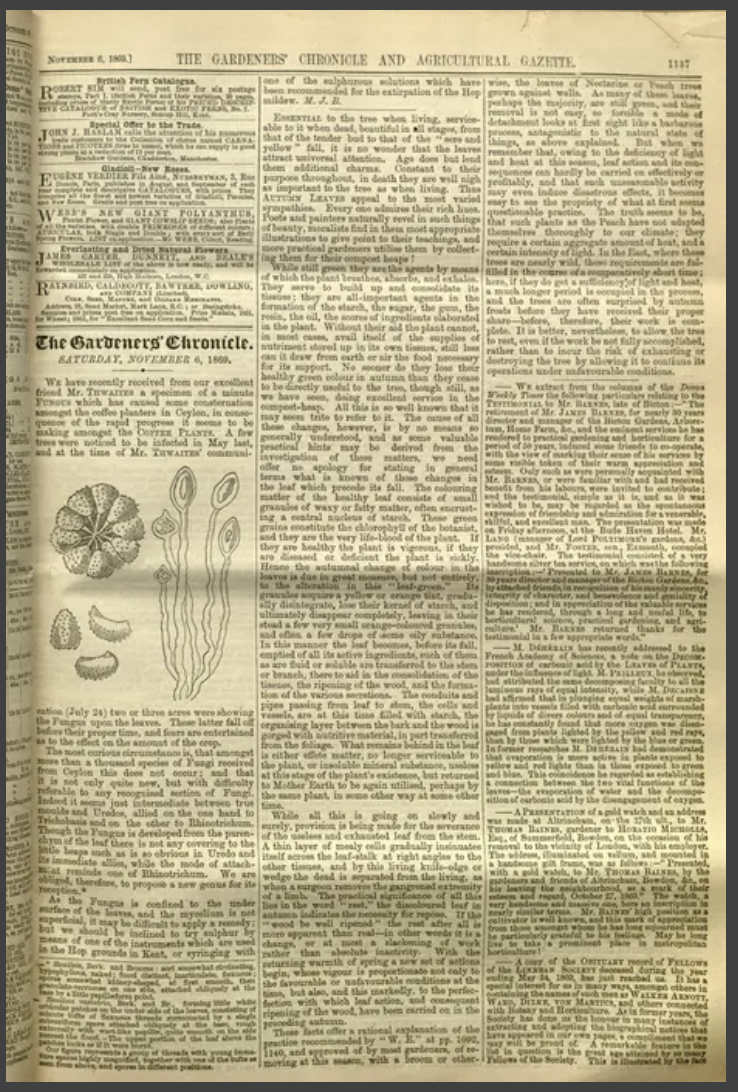
Unsigned figure, detail from The Gardeners’ Chronicle and Agricultural Gazette, 6 November 1869, p. 1157. London, published for the proprietors, 1844-1873. Missouri Botanical Garden, Peter H. Raven Library, via the Biodiversity Heritage Library. Public domain.
The plant that was happier
So around the turn of the twentieth century they tried something else: robusta.
Coffea canephora. Native to central and western Africa, and by every measure that mattered to a planter, the better bet. It tolerated the heat. It shrugged at the humidity. It resisted the rust in a way arabica never could. It yielded more per hectare, it was cheaper to grow, and it suited the plantation scale the colonial system was built around. It arrived around the turn of the twentieth century, which is as precise as the record lets us be.
Robusta, it turned out, was the happier plant.
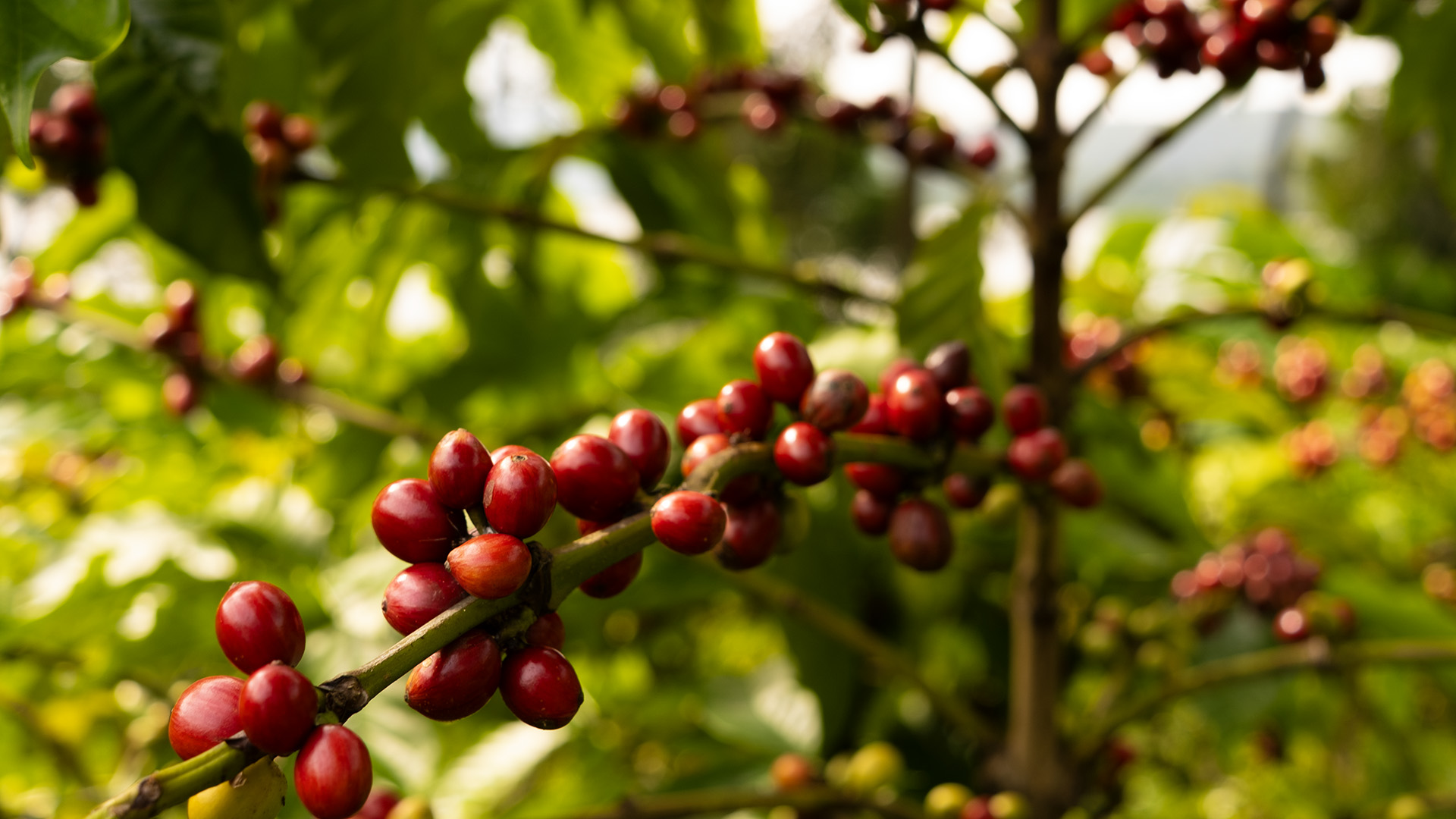
Central Highlands
which species they were. Standing there, we would not have known what the answer meant.
It came at a cost, and the cost was reputation. Robusta became the bean of instant coffee: useful, cheap, strong. Italian and Portuguese roasters have long blended it into espresso for body, caffeine and a fuller crema, but rarely has it been treated as the point of the cup. It is more bitter than arabica, more forceful, and carries close to twice the caffeine. In the specialty world, “robusta” has long been half an insult.
Sit on a plastic stool in the Old Quarter, though, and the insult stops making sense. The coffee in your glass is robusta, and it is superb, and everything around it has been built to make it so. The condensed milk. The egg yolk whipped into a foam. The coconut, the yoghurt, the salt. These are not decorations on a weak coffee. They are the answers a culture worked out to a bean that is dark and bitter and enormously strong, and they are answers nobody in Europe was asking for, because nobody in Europe was drinking this.
That is the part the colonial story misses. The French introduced the plant. They did not invent what Vietnam did with it.
The boom nobody was watching
The last chapter is the one that explains why we had never heard any of this.
In 1986 Vietnam launched Đổi Mới, the economic reforms that opened the country up. Coffee was one of the things that came pouring through the gap. Through the 1990s, planting in the Central Highlands expanded at a pace that has few parallels in modern agriculture, and by the end of that decade Vietnam had become the second largest coffee producer in the world, and by some distance the largest producer of robusta.
It happened inside about fifteen years, from Đổi Mới in 1986 to the turn of the millennium, tens of thousands of tonnes to nearly a million. It happened while America still held the country under a trade embargo, one not lifted until February 1994, by which time the boom in the Central Highlands was already under way. It happened while Britain was beginning its own coffee revolution, espresso bars and café culture and the first stirrings of an obsession with origin. And it happened to the bean that coffee’s emerging quality hierarchy had put at the bottom.
So there was a reason the story had not reached us. It was too recent, and it was about the wrong bean.
Almost all of Vietnam’s coffee is robusta now, grown by millions of smallholder farming families, each one a small part of one of the great coffee stories of the last century. We did not know that when we sat down in that bookshop with two cups going cold beside us. We are not sure we would have believed it.

Hanoi
The French may have introduced coffee to Vietnam. But it was Vietnam that discovered which plant was happier here, and then spent a hundred years working out what to do with it.
Grounds for discovery
This piece came out of three days of Bean Hunting in Hanoi. There is more of it.
What we checked, and what we could not
Four claims in this piece were opened, examined and either closed or left honestly open before publication.
The 1857 introduction date. Retained only as the commonly reported date for missionary introduction of arabica to church sites. Not described as proven by a located primary record.
Church introduction before colonial control. The reported 1857 missionary plantings pre-date French control of the north. The prose separates church introduction from colonial administration, and the conquest dates follow the staged record: eastern Cochinchina ceded 1862, the west annexed 1867, Annam and Tonkin protectorates from 1883 to 1884.
Where the 1857 arabica stock came from. We do not know. A later, better-documented 1887 Tonkin planting used arabica seed from Réunion. That cannot be projected back to 1857, and we have not projected it.
The 1869 Ceylon rust observation. Confirmed against the primary facsimile: The Gardeners’ Chronicle, 6 November 1869, p. 1157, read at the Biodiversity Heritage Library. The specimen came from a Mr. Thwaites, in a communication dated 24 July, and the page names him no further than that, so neither do we.
The year robusta was first planted in Vietnam. Not stated. “Around the turn of the twentieth century” is as far as the record lets us go, and no year has been invented to fill the gap.